

How do you know when it is time to transition into a new role? I approach it in three ways:
- It was never mine to keep.
- Capable leadership to “take over” is in place.
- The underlying programmatic and financial health of the organization is strong.
It Was Never Mine to Keep
The hardest part of any transition isn’t stepping back from the work — it’s letting go of the idea that the work was ever “yours” to begin with. I didn’t build Nature For Justice (N4J). We did. The frontline communities we’ve partnered with, the funders who bet on an unproven idea, the staff who showed up every day to do the unglamorous work of making change real — the organization belongs to all of them, and to everyone who carries it forward from here.
That’s why stepping into the role of Strategic Advisor feels less like an ending and more like keeping a promise. The promise was never that I’d run this organization forever. It was that I’d help build something durable enough not to need me to.
My first N4J blog, written in August 2020, was entitled “Help People Where They Are“, and in it I described the work in the Somali refugee camps with my leading employee, Mohamed Ali Noor. Mohamed died shortly after I left Somalia — he never got to see the fruits of our labor, though the work went on to be a big success. I dedicated that first blog to Mohamed, and I think he would be proud of what we have done with Nature For Justice.
Capable Leadership
At N4J, we’ve been able to attract and build a highly qualified team of professionals. I feel confident that Nicci Mander (taking my job as CEO), Steven Nitah, Robin Barr, Patrick Brown, Ray Jeffers, and Board Chair Kate Thompson will lead the organization to new heights of progress and impact. And the administrative and Board support of Sunny Bain and Debbie Cohen, who have been on and off with me for many of my endeavors since 2001 has been consistently the highest quality.
Despite the criticism of “diversity” these days, it is a major strength of N4J. The mix of skills, cultures, backgrounds, and ethnicities enables us to think about and create programmatic plans that take advantage of this diversity.
We have a team including a Canadian First Nation elder, two 4th generation Black farmers from the US Southeast, several South Africans with decades of experience working across the African region on poverty and environment issues; US and Canadian team members with corporate sustainability, financial modeling, carbon project development, and Indigenous Peoples engagement experience. Nearly two-thirds of our team, board, and major contractors are women. (Here’s the whole N4J Team)
Underlying this diversity is a common commitment to N4J’s vision and mission, the strategy we’ve developed, and the knowledge that there will be roadblocks — but the skills are there to work through those challenges.
Finally, the leadership must trust one another, our partners, and the local people we engage with. Our approach is to work with local people to co-create programs, and to jointly build a bridge to companies, foundations, investors, and supporters. It all starts with N4J: the leadership, including the Board, must trust the judgement and professionalism of all team members.
Programmatic and Financial Health
Our programmatic focus has shifted over the years. Our Africa nature-based solutions program, with the support of a major funder and under the leadership of Michael O’Brien Onyeka and Nicci Mander, was our leading program for a couple of years. But a strategic shift by the funder gutted the program, and because our 21-project portfolio was, for the most part, too early stage for emerging nature credit investment, we were unable to attract new capital. (The disappearance of USAID didn’t help). The program has contracted and we remain bullish for two potential projects in South Africa and our emerging program with Alabaster International in Ethiopia.
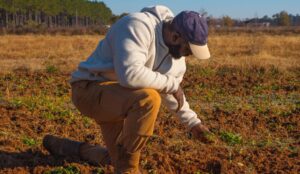
Our US-based Farmer Prosperity program has been growing steadily since its start in 2021, and partners like The Soil Inventory Project helped us make the leap to a major program with USDA support. Ultimately, 210 underserved farmers became part of our network in VA and NC. But, as it happens, the new administration cancelled its support. Under the leadership of Patrick Brown and Ray Jeffers, both 4th generation farmers, the program has proven resilient as we have diversified our funding base and are now looking to expand into the Mississippi Delta with partners like Seanicaa Heron of Freedmen Heirs Foundation.
Our Canada program has been steady. It was EVP Steven Nitah, former Chief of the ŁuTsël K’e Dene First Nation and lead developer of Thaidene Nene, a 26,000km2 Indigenous Protected and Conserved Area (IPCA) in Canada’s northwest Territories – who created a vision of First 30×30, and with the major assistance of Robin Barr and Tess Zakaras, it has attracted support from RBC and the BHP Foundation. It is thriving.
My co-founder, Frank Hicks, has worked tirelessly to lay the groundwork for expanding our efforts the right way in Latin America, and that will come.
Having worked on these issues for years, I knew that putting “all of our eggs into one basket” would put the entire organization at risk for reasons outside of our control (see above). So, we deliberately diversified from Day 1. The portfolio approach also allowed us to maintain a healthy balance sheet and income statement.
The lesson: build a diverse portfolio, with the right people and partners, steadily.
In closing, let me say that I’ll still be here and I’m evolving into a role that suits the organization’s needs today and prepares it for an exceptional future.