


Part 3 of 4: Resilience for Nature-Based Solutions: Insights from People and Nature
One of the key reasons why humans are so successful at driving progress is our capacity to share knowledge and innovations with others – ideas which live on and are passed down to new generations, shaping the course of our evolution. The global development sector in particular takes on the primary role of scaling good ideas for the benefit of humanity and is constantly grappling with the question of how to do it most effectively. Fund solutions at scale, institutionalize them through policy, roll them out across geographies – and change will follow.
Yet when it comes to resilience, this logic frequently falls short. Not because the ideas are wrong, but because resilience is not a standard product to be delivered. It is a capacity that must be enabled and grown from within communities, ecosystems, and the reinforcing relationships between them.
So how do we scale something that is inherently local, context-dependent, and relationship-based?
Three Pathways for Scaling
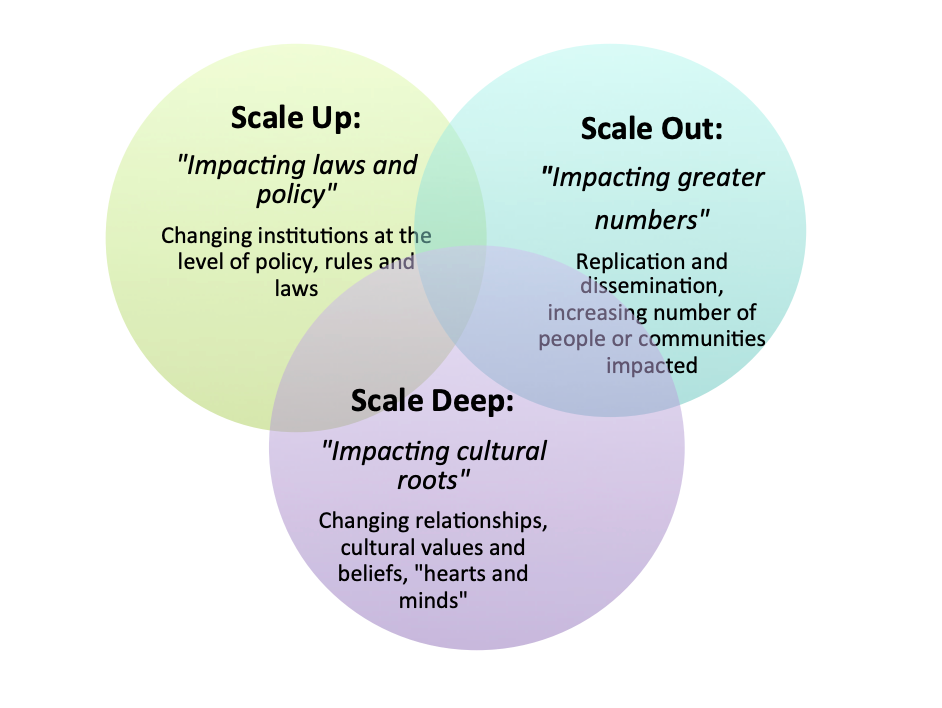
Research on scaling social and environmental innovation offers a useful reorientation. Moore et al. (2015) identify three distinct pathways through which systemic change can be achieved: scaling up, scaling out, and scaling deep. Rather than treating scale as purely a matter of reach or volume, this framework recognizes that durable transformation requires movement across all three dimensions.
Scaling up refers to influencing policies, institutions, and funding mechanisms so that they support resilience. This is the domain of governments, development banks, and international organizations, which can embed resilience principles into regulatory frameworks, financial instruments, program strategies, and national adaptation plans.
Scaling out is about replication and peer-to-peer diffusion: spreading proven approaches to new actors, communities, or geographies through inspiration and knowledge exchange. It is horizontal rather than vertical.
Scaling deep is perhaps the most complex to apply in practice, yet most foundational. It refers to shifting the narratives, values, and cultural beliefs that shape how people relate to each other, to nature, and to change and uncertainty. Without this deeper transformation and anchoring, policies and programs remain fragile, vulnerable to political cycles and external shocks.
A Divergence in Practice
My research with smallholder farming communities revealed a striking pattern: ‘bottom-up’ communities and ‘top-down’ institutions tend to scale in very different ways, and rarely in coordination.
The communities I worked with across Colombia, Cuba, Ethiopia, Indonesia, and the Kurdistan Region of Iraq were doing something remarkable – they were scaling resilience without following a prescribed model. Their scaling was organic, relational, and deeply rooted in shared values.
Scaling Out
In Colombia, farmers were trained as local teachers and passed on climate adaptation knowledge across regions to other communities, with coffee cooperatives enabling knowledge and skill exchange and reducing the need for any single individual to hold all the expertise.
Whereas, in Indonesia, researchers observed that farmers were more prone to adopting new agroecological practices when seeing the success of pioneering farmers, sometimes by simply replicating what they had observed in a neighboring field – one memorable example being a farmer who stole ducks from an experimental farm to establish his own Complex Rice System, demonstrating the potential of organic replicability without any formal intervention. In Cuba, the Finca del Medio family’s agroecological model spread through the inspiration it offered to other farming families through farmer-led exchange, rather than formal programs. These communities were scaling out through peer exchange and knowledge-sharing.
Scaling deep
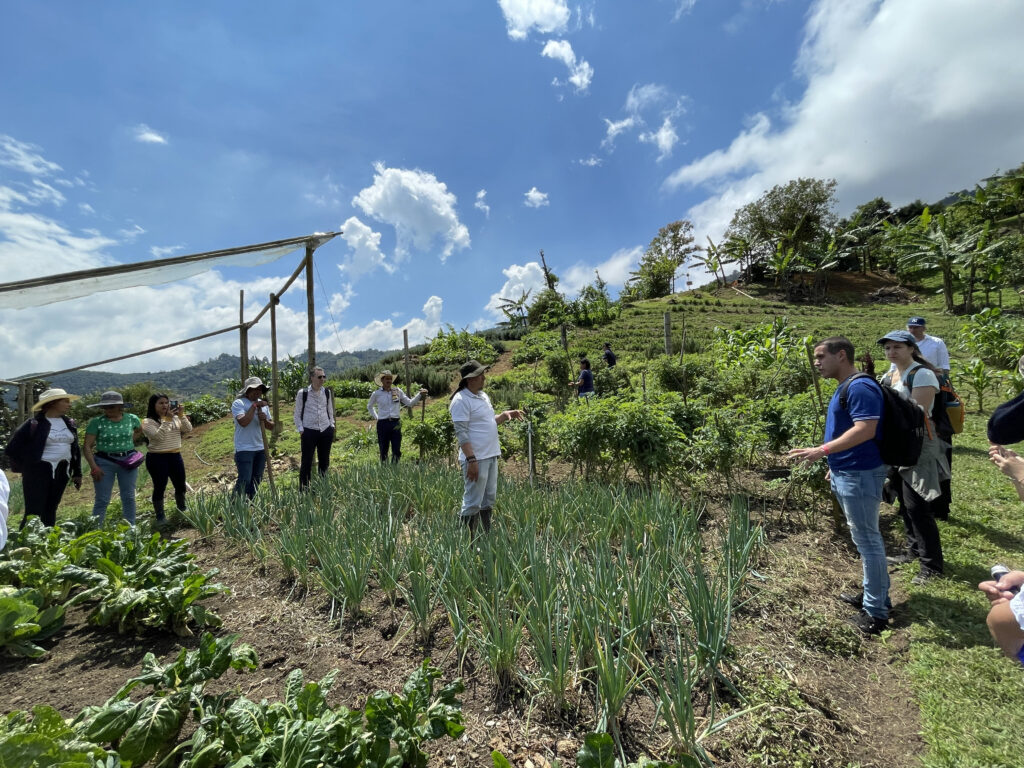
Crucially, the purpose of resilience for these communities was itself distinct from institutional framings. When asked what resilience meant to them, instead of productivity targets or business risk mitigation, farming community members emphasized well-being, autonomy, meaningful work, and balance with nature. Their strategies reflected this: prioritizing food self-sufficiency and security over market integration, circular and diversified production systems over efficiency, and taking care of their community members through informal solidarity networks and cultural events when institutional financial support was lacking. This values-driven orientation shaped not only how they built resilience, but how it spread through trust and demonstration, and was anchored in shared identity.
Scaling up
Global development actors, including the organizations I analyzed in my research, such as GIZ, the Gates Foundation, Rabobank, and the World Bank Group, concentrated their efforts predominantly on scaling up: creating policy frameworks, mobilizing blended finance, establishing institutional partnerships, and building national-level capacity through tools like climate risk insurance, digital agricultural platforms, and certification schemes. These are all important efforts. Institutional mechanisms can provide opportunities to communities that they would not have otherwise: access to markets, legal recognition, protection against systemic shocks, crisis relief, and long-term investment in public infrastructure.
Potential gaps
When comparing top-down and bottom-up strategies, a significant divergence emerges in how resilience is understood and pursued. Some top-down strategies frame resilience through the lens of risk management, productivity growth, and a need for smallholder farmer integration into commercial value chains. When designed narrowly, these approaches can privilege market-oriented actors, formalize systems that communities already manage informally, and under-appreciate the informal safety nets, culturally embedded governance, and autonomy that often underpin resilience in practice. However, this is not the case for all sector approaches: many contemporary resilience frameworks increasingly emphasize participation, equity, and context-specific design. The main risk arises when scaling efforts are pursued without adaptation to local social and ecological conditions, in which case interventions may bypass and weaken the communities they intend to support (Conti et al., 2025).
The result is a potential gap between intention and impact. Development strategies may identify smallholder farmers as their primary beneficiaries, yet the solutions offered may reflect institutional priorities and logics that diverge from farmers’ lived realities. Policies designed at the national level may not trickle down to the farm. Financial instruments designed for formalized actors may exclude the most vulnerable. Knowledge exchanges that flow in one direction – from institution to community – miss the depth of local expertise that could, in turn, inform better policy. As my research findings suggest, farmers often gained a seat at the policymaking table only after they have already demonstrated resilience entirely on their own.
The Synchronization Opportunity
The tension between bottom-up and top-down approaches is not new, but it remains one of the most persistent challenges in system transformation. It is worth noting that not all top-down action is extractive or blind to local systems, many institutional actors are genuinely committed to ensuring equitable design and participation. Equally, not all bottom-up action is automatically more resilient or fair. Community-led processes can reproduce exclusions or concentrate power in informal leaders. The question is not which approach is inherently superior, but how their respective strengths can be brought into productive alignment.
What is needed is synchronization – an intentional alignment between bottom-up and top-down approaches, which tend to gravitate toward different scaling pathways. The opportunity lies in complementing communities’ tendency to scale out and deep, with institutional scaling up strategies. This means designing institutional programs that actively create space for community-led scaling to flourish alongside top-down mechanisms. For example, funding that follows community priorities, policies that reflect local realities, and knowledge exchange that flows both ways.
Implications for Nature-Based Solutions
For Nature-based Solutions (NbS) to deliver enduring outcomes, the same logic applies. Technical restoration projects are most durable when co-developed with and embedded within communities that understand them, value their outcomes, and own their governance. When scaling up through top-down tools such as policy, certifications, and carbon market mechanisms, it is worth being mindful of who holds the power in these arrangements, and who bears the risk if conditions change.
Scaling resilience through NbS means creating enabling environments rather than applying blanket approaches. It means investing in the local leadership, knowledge infrastructure, cultural coherence, and value alignment, to allow local systems to continue building resilience long after external programs conclude.
Like healthy ecosystems, resilient social-ecological systems are most likely to thrive when embracing diversity and local specificity, connectivity, and distributed stewardship. Scaling resilience is then less about expanding a model and more about multiplying the conditions under which resilience can grow.
In the next concluding part of this series, we’ll explore the latest discourse around resilience and nature, the need to move away from an ‘efficiency’ narrative, and ways to better incorporate risk into institutional approaches.
References
Conti, C., Hall, A., Moallemi, E. A., Laila, A., Bene, C., Fanzo, J., Gibson, M. F., Gordon, L., Hicks, C., Kok, K., Rao, N., Laxminarayan, R., & Mason-D’Croz, D. (2025). Top-down vs bottom-up processes: A systematic review clarifying roles and patterns of interactions in food system transformation. Global Food Security, 44. https://doi.org/10.1016/j.gfs.2025.100833
Moore, M. L., Riddell, D., & Vocisano, D. (2015). Scaling out, scaling up, scaling deep: Strategies of non-profits in advancing systemic social innovation. Journal of Corporate Citizenship, 58, 67–84. https://doi.org/10.2307/jcorpciti.58.67